Fire, Altar, Song
remembering the path of the ancestors

For this third and final post about my five days on the land for the Salmon of Wisdom retreat, I want to share how Aoife Lowden wove us together with her ceremonial touch, complementing what both Michael and Dougie brought in parts one and two of this retreat reflection.
You can learn more about Aoife’s work on her site, Slí na Sinsear “The Path of the Ancestors” where she writes:
Aoife’s work is rooted in the ancient mythology of Ireland and Scotland, from the Dé Danann to the Fianna. Her work is cultural and ancestral recovery rooted in the landscape and in dùthchas — a return to communal belonging with the land.
Beginning With Fire
To welcome us to The Shieling – a Gaelic culture camp on the River Farrar just west of Inverness – Aoife entrusted each of us with a small cut of wood.
At most events I’ve attended, we build a fire and then begin. But here, things unfolded differently. Aoife and Michael gathered flammable materials from the land and built a delicate nest. They then began a friction fire using a bow drill. This wasn’t a skill demonstration but an initiation into a much older way of doing things, where survival (physical, social, spiritual) once depended on the warmth and glow of flame. I’ve since come to learn a bit more about Force Fires (Teine Eigin) as a Celtic ritual once used to cleanse, renew, or mark communal thresholds.
What I had never seen before was the way they did it: each holding one end of the bow, summoning a sacred fire together through intention, humility, and song. Back and forth, back and forth, we travelled and we remembered. We were invited to join their song into a shared rhythm of patience, reverence, and gratitude. A smouldering ember was born and was then placed in the nest and passed from hand to hand, each of us offering our breath, presence, and hope.
Aoife didn’t explain what this moment meant. She didn’t need to. I remember feeling that the way we tended to this young fire carried the weight of how the rest of the retreat would unfold – and somehow, even, how the earth might endure.
Once the central fire went from a crawl to a tentative walk, we each introduced ourselves and fed our piece of wood into the maturing flame. Our facilitators ignited the spark of the retreat, but it was up to participants like me to keep it burning.


Remembering the Old Ways
Throughout the retreat, Aoife contextualized what we were doing and why it mattered. She is a treasure chest of Gaelic and Celtic knowledge, embodying her own ongoing journey of cultural recovery. No matter our background or familiarity with the lore, she placed herself alongside us, not as a keeper of fixed tradition, but as someone walking the ancestral path, too.
“The culture is not lost to us – we are lost to the culture,” she said once, with a blend of pride, grief, and fierce devotion.
There is a growing movement of people piecing together ancestral fragments and what draws me to Aoife’s work is that she centers the Land and the myths as the heart of culture and not human desire, nostalgia, or extraction. We feel lost without a deeper story of who we are and why we are here, but the knowledge remains – waiting for those willing to apprentice themselves to the earth’s language. For Aoife, myself, and others in the group, the salmon holds much of that deeper story.
As mythologist Stephanie MacKay says, “If we remember the stories, they will re-member us.”
Aoife also reminded us as a group of white people, that whiteness is not synonymous with consumerism, disconnection or domination. We, too, have indigenous ancestral lifeways that honoured the Earth. Two key Gaelic concepts guiding both the Shieling Collective and our retreat were:
Dùthchas: an inherent connection and sense of belonging to a specific place, ancestry, and cultural tradition.
Dualchas: the customs, stories, and living practices that define a community and are passed through generations.
These two concepts quietly shaped everything we did.


Salmon Ceremony on the River Farrar
On the third day, Aoife gathered us for a salmon ceremony by the river. To honour the spirit of the experience, I’ll share only a part.
After washing and tidying ourselves up as if we were going on a date, we walked in procession to a tucked-away spot along the Farrar. Aoife had arranged river stones into the shape of a salmon. This would be our altar. After her invocations, we each introduced ourselves to the river and offered blessings.
The River Farrar, like many rivers in Scotland, has seen wild salmon numbers collapse over the past two decades. The River Boyne – so central to many versions of the Salmon of Wisdom tale – had one of its worst years in 2025, with only 5% of salmon returning from the sea. Standing there, the mythic and ecological stories braided together with a quiet and aching clarity.
After the ceremony, we found ourselves slipping from song into the river herself, our solemnity giving way to full-bodied joy. The Dualchas were alive in us; the Dùthchas stirred beneath our feet. Something honest passed between us and the water. It was an encounter that felt both ancient and timely.


Singing the Salmon Home
On our final morning, bags ready and carpooling sorted, we gathered for one last salmon ceremony. Perry, who was our chef and modest operations wizard, and Aoife placed a small raft of birch bark into the river, carrying salmon bones downstream as we offered gratitude and hopes for the years ahead.
In silence we watched the delicate raft turn the bend and into the beyond. The mythic and aquatic story of the salmon also carried a personal resonance for many in the group. Trying to find one’s way home among the wreckage of modern society also felt like an upstream effort, using navigational senses we don’t fully understand. Perhaps it’s the poetry of the salmon and the medicine of the salmon (as described in Dougie’s mythopoetic approach in part two of this series) that give us kinship with wild salmon at home within the Atlantic Ocean and the uncountable number of rivers and streams along ancestral coastlines.
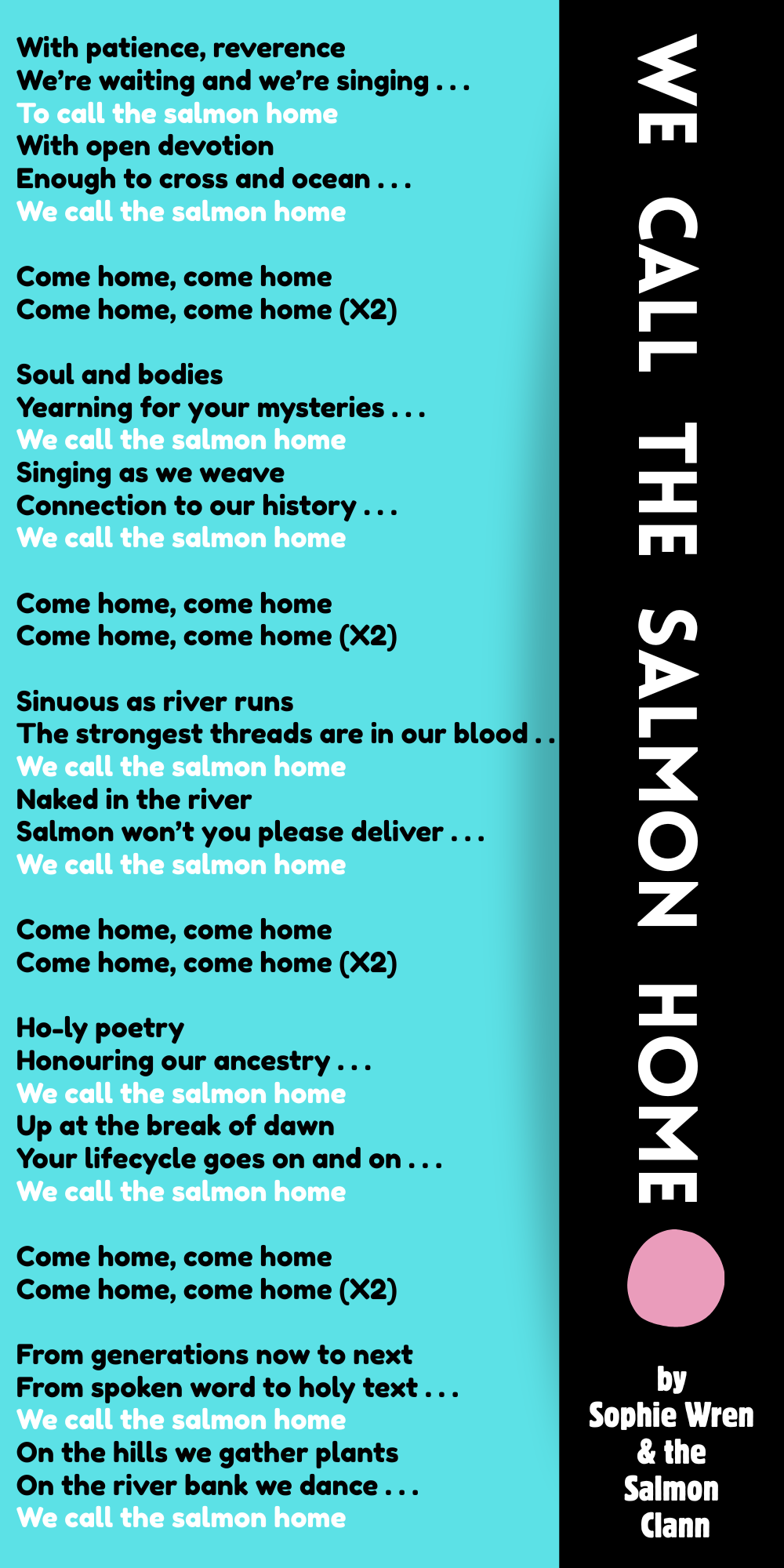
Aoife patterned the retreat with beautiful songs. Thanks to Sophie for finding and starting our tune, we eventually all joined the creative process adding our own observations and aspirations from the retreat. By the end, we had created a new song – woven together collaboratively, just like everything else. We sang it endlessly and during our last shared moments once our raft had long carried our love. I only later realized it had rooted itself within me: an earworm, yes, but also an embodied echo of my time in the Highlands.
In the end, perhaps what these stories and reflections offer is not a map but a way of listening. The Salmon of Wisdom doesn’t hand us answers; it swims just ahead, flicking its tail toward something we can sense but never fully grasp. It invites us into a slower attention, where learning feels more like remembering, and remembering feels like entering an old conversation already in progress.
If there’s any guidance to follow, it might be found in these small recalibrations: keeping company with the land long enough that its rhythms begin to shape our own; letting stories open a space where our inherited certainties soften; noticing when our hearts are tugged toward repair, even if we do not yet know what repair entails. These are quiet practices, provisional and unfinished—just like us.
In this shared work, we move not as experts but as learners, following the glimmer of something ancient and still alive. The Salmon swims on ahead, and we follow as best we can, trusting that wisdom is not a possession but a relationship—one we renew each time we listen deeply, act gently, and remember that we, too, are part of the river.
I just learned that the Salmon of Wisdom retreat will be offered again in July of 2026. Follow the Shieling Collective’s website for details when they get posted.
Let me know what you think of this post or for any in this 3-part series. It’s always nice to read some comments.


I loved reading this series. Honouring of land, river and salmon, community and culture , story and craft.