Sharing the Story
awakening the Salmon of Wisdom myth at public events

It’s September in the Lake Ontario watershed and that means that Salmon nation is returning to their natal rivers and streams to spawn. The start of the school season for humans also marks the anticipation of schools of Salmon by anglers, photographers, river watchers, conservationist and also the winged, four-legged, and insects who rely on salmon bodies for their daily meal.
Port Hope has been marking this homecoming for the past 4 years with their Run Salmon Run event. Organizer Sean Carthew helps celebrate dozens of initiatives that engage people with their relationship with Salmon. For just a few hours in a park beside the Ganaraska river, hundreds of people of all ages gather and mingle along the riverbank. With a moratorium on fishing until later in the Fall, event goers are caught by the salmon — tens of thousands of them — on this ancient cycle of life that has been happening in this watershed for over 10,000 years.
Almost all the returning salmon are varieties of Pacific Salmon and about half of these Salmon reproduce in the watershed naturally and the other half raised in hatcheries and stocked. The native Atlantic Salmon went extinct less than 100 years from when European colonial settlements started growing in the watershed with the last one caught and recorded in 1889. Since 2006 an Atlantic Salmon restoration project has been running, but there are still very new Atlantic Salmon returning each fall and the ones that do have been raised in hatcheries.
This year marks my third year with a tent space at the event. My first time was a chance to show off some of the salmon and kinship craft I made along with a sensory salmon activity. Last year I organized a Sing Back the Salmon experience where a dozen people braided song, gratitude, grief, and humble presence on the riverbank. I also created and distributed 100 zines (little magazines) to accompany this special with-nessing. This year I am retelling the tale of the Salmon of Wisdom — a Celtic myth awakening ancestral echoes and land-informed ethical relations. I’ve also made a zine to accompany this experience with some key quotes and prompts to ponder.
I’ll reproduce parts of this experience here, but if you happen to see this post before September 7th at 11am, come join us. Subscribe to this Substack to read about upcoming posts including my recent experience in Scotland at the Salmon of Wisdom mythopoetic and ancestral skills retreat hosted by Dougie Mackay, Aoife Lowden, and Micheal Wachter.
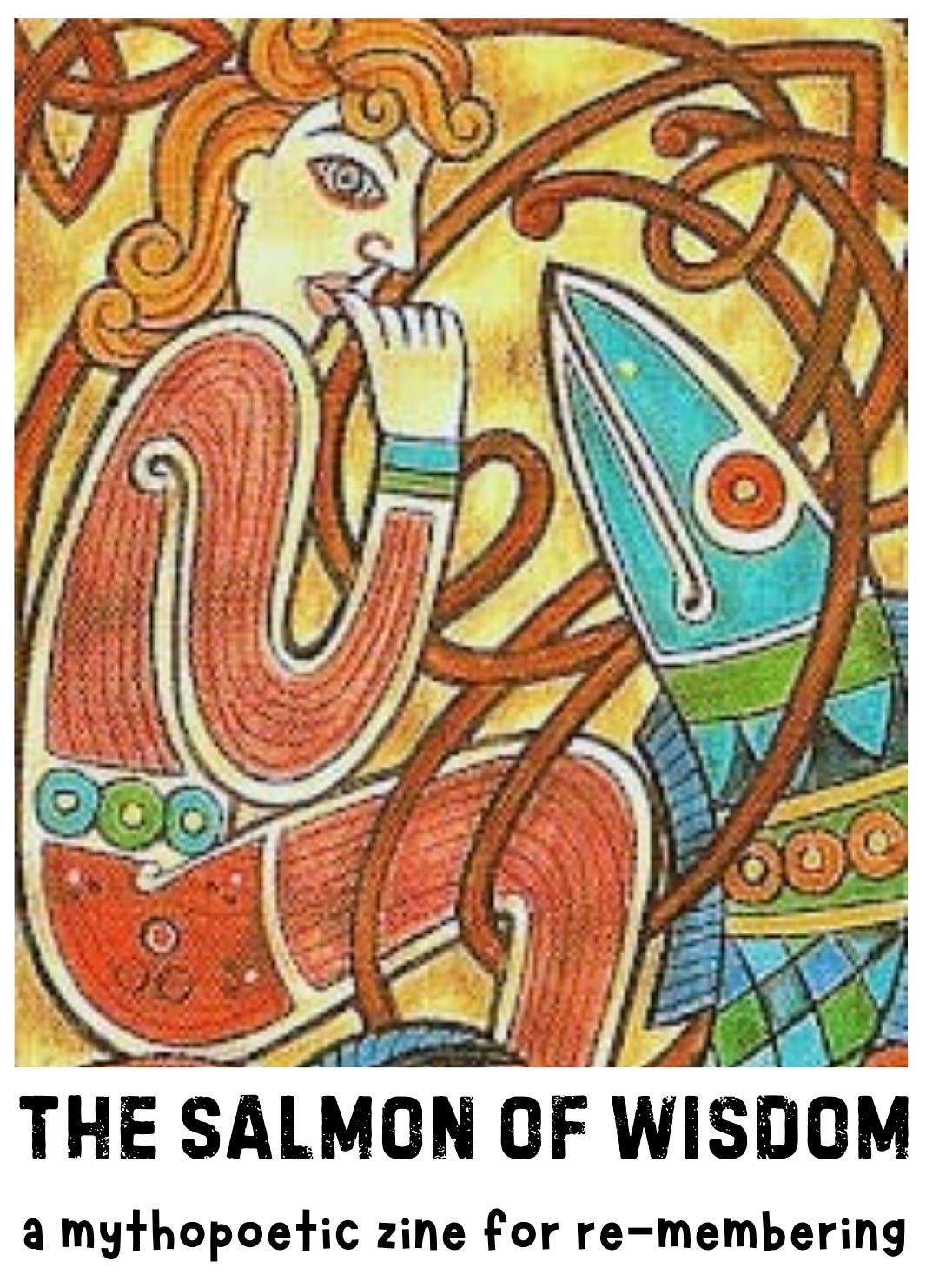
The Framing of the Story Experience
This story is not here to be solved, explained, or mastered. It is here to be walked with.
Like salmon returning upstream, myths return again and again — carrying memory, nourishment, and responsibility. This tale of the Salmon of Wisdom is an ancestral echo and a living teacher.
As you read, listen, or share, let the story ripple through you like a stone dropped into still water. Notice what catches in your body, what lingers in your dreams, what shifts in your sense of kinship with the river, the salmon, and each other.
May these words not just tell a story, but re-member us to the wider web of life.
A reading of Celina Buckley’s book The Salmon of Knowledge.
Discussion Questions:
The Salmon as Teacher
– What might change if we imagine salmon not as something humans must save, but as elders who carry teachings for us?
The Fire on the Tongue
– In the myth, wisdom comes through a burn. In your own life, what moments of discomfort or “burn” have opened new ways of seeing?
Between, Not Within
– Where do you notice wisdom arising in the “in-between” — between people, between human and land, between generations — rather than inside one person alone?
Myth as Memory
– Why do you think this story was told and retold for so many centuries? What part of cultural or ancestral memory might it be carrying into the present?
The Returning Salmon
– Salmon swim out into the vast ocean, but always try to return home. What does “returning home” mean for you — personally, culturally, or ecologically?
The zine includes these notes plus a few more:
“Wisdom is not in us, but between us.” — Vanessa Machado de Oliveira, in “Outgrowing Modernity: navigating complexity, complicity, and collapse with accountability and compassion
➤ Ponder: What relationships with people, places, or more-than-human kin are asking you to listen for wisdom?
“If we remember the stories, the stories will re-member us.” — Stephanie Mackay
➤ Ponder: What stories in your lineage or landscape might be waiting to re-member you?
“Myths never were, but always are.” — James Hillman
➤ Ponder: How is the Salmon of Wisdom not just a tale of the past, but alive in today’s rivers, today’s crises, today’s choices?
“Seek sense-fullness rather than meaningfulness.” — Gesturing Towards Decolonial Futures Collective
➤ Ponder: What sensations does this story awaken in your body? Where do you feel it most strongly?
“Just as mushrooms are the fruiting bodies of underground mycelia, so are myths the aboveground manifestations of specific ecologies.” — Sophie Strand
➤ Ponder: If this salmon story is a fruiting body, what unseen “mycelia” of memory and ecology lie beneath it in your place and time?
“We must let these stories ripple through our emotional bodies like a stone dropped into a still, dark pond.” — Simon Yugler
➤ Ponder: What ripples has this myth set moving in you?
“The culture is not lost to us, we are lost to the culture.” — Aoife Lowden
➤ Ponder: What practices or relationships might help us swim back toward the culture that remembers us?
The story experience closes with a simple gesture to help ground the story and discussion in the singular and collective body. Get in touch if you would like to bring this mythic experience to your event or community.
